Hits: 20
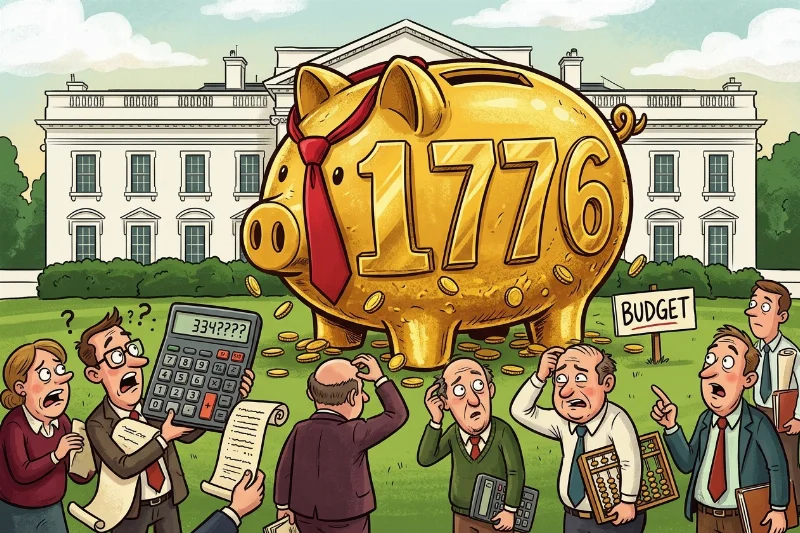
So, it turns out someone has found a spare $1,776 billion lying around in the couch cushions of the federal budget. You have to hand it to them—the branding is impeccable. Using the year of our independence as a price tag for a massive pile of cash is the kind of marketing genius that usually requires a three-martini lunch and a very expensive consulting firm. But before we start printing ‘Freedom Bucks,’ let’s take a closer look at this supposed slush fund.
The $1,776 Billion Dollar Question
When you hear a number that sounds like a historical anniversary, your skepticism alarm should probably be ringing louder than the Liberty Bell. We are talking about a trillion and a half dollars plus some change, which is enough money to buy every professional sports team in the world and still have enough left over to purchase several small, slightly used European nations. It is a figure that feels more like a creative writing prompt than a fiscal reality.
Calling it a ‘slush fund’ is also a bit of a classic. In Washington, a ‘slush fund’ is any pile of money that your political opponent wants to spend, while a ‘vital strategic reserve’ is any pile of money you want to spend. The problem with this particular bucket of gold is that it seems to be more of a theoretical exercise in accounting gymnastics than an actual checking account waiting for a signature.
Why the Numbers Don’t Add Up
If you try to find this $1,776 billion on a spreadsheet, you might find yourself squinting until your eyes hurt. In the world of federal budgeting, money isn’t just sitting in a vault like Scrooge McDuck’s swimming pool. It’s usually tied up in things like ‘obligated funds’ and ‘statutory requirements’—which is government-speak for ‘we already promised this to someone else and they have a very good lawyer.’
Mathematically, the number is so suspiciously round and patriotic that it feels like it was calculated by a guy wearing a powdered wig and a ‘Make America Great Again’ hat. Real budgets are messy; they end in numbers like .42 cents. When a budget ends in three zeros and matches the birth year of the nation, you can bet there is some heavy-duty political theater at play.
Donny’s Big Piggy Bank
Now, our friend ‘Donny Boy’ seems to think this money is his personal piggy bank for whatever projects strike his fancy. Whether it’s building walls made of pure patriotic energy or gold-plating the national parks, the idea of a single executive branch official having a trillion-dollar debit card is enough to make the Founding Fathers do a collective 360-degree spin in their respective graves. The Constitution, pesky as it is, usually likes Congress to have a say in where the coins go.
Accountants at the GAO are likely having heart palpitations just thinking about the paperwork. You can’t just move a trillion dollars from the ‘Things We Might Need’ column to the ‘Stuff Donny Wants’ column without triggering every legislative tripwire in the tri-state area. It’s not just a matter of moving numbers; it’s a matter of navigating a labyrinth of legal restrictions that are designed specifically to stop this exact kind of thing.
Constitutional Speed Bumps
Even if the money existed in the way it’s being described, the checks and balances of our system aren’t just suggestions written on a cocktail napkin. The ‘power of the purse’ belongs to Congress, even if that purse is currently held together by duct tape and prayers. Trying to bypass the legislative process to tap into a $1,776 billion fund is like trying to drive a monster truck through a car wash—it’s going to get messy, and someone is definitely going to lose a side mirror.
Public perception is another hurdle. While ‘1776’ sounds great on a bumper sticker, the average taxpayer starts to get a little twitchy when they hear about trillions of dollars being shuffled around like a three-card monte game on a New York City sidewalk. Transparency in government is already an oxymoron, but this takes the ‘creative’ out of ‘creative accounting’ and puts it firmly into the ‘fantastical’ category.
Wrapping Up the Receipt
At the end of the day, the $1,776 billion slush fund is a beautiful dream for some and a fiscal nightmare for others. It serves as a reminder that in politics, if a number sounds too good to be true, it probably involves a lot of smoke, a few mirrors, and a very optimistic interpretation of the tax code. So, hold onto your wallets, folks—Donny Boy might have big plans, but the math is still waiting for its invitation to the party.