
Hits: 108
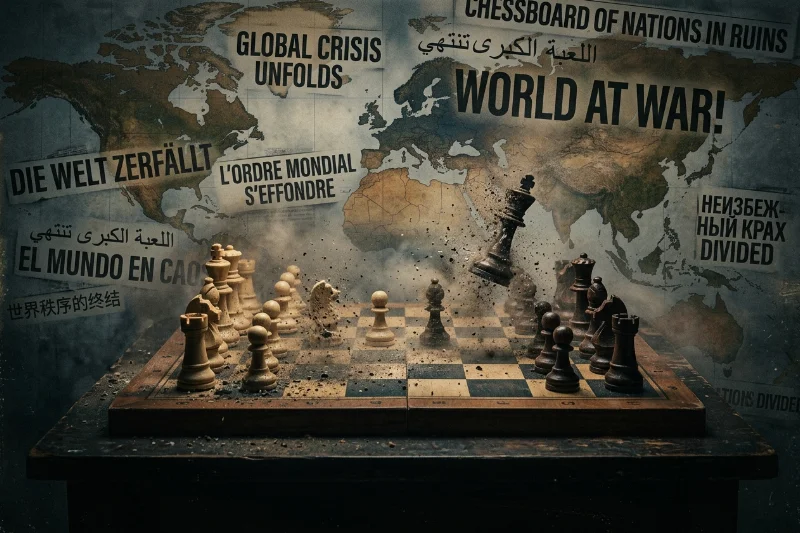
History, as the old adage goes, is written by the winners. However, in the complex landscape of 21st-century geopolitics, the definition of a ‘winner’ has become increasingly fluid, if not entirely obsolete. Modern conflicts rarely end with a signed treaty on a battleship; instead, they dissolve into a persistent state of low-intensity friction. This ambiguity is not accidental but is often a deliberate choice by global powers to avoid the accountability that comes with a definitive conclusion.
As we analyze the fallout of recent decades, we see a shift from total victory to ‘managed instability.’ The lack of a clear end-state allows for the continuation of military funding, political maneuvering, and the maintenance of spheres of influence without the burden of rebuilding a conquered nation. The question of who won is no longer answered by maps, but by the preservation of status quo for those in power.
The Fog of Narrative and Revisionism
The battle for narrative is often more fierce than the kinetic battle on the ground. In the information age, every side possesses the tools to broadcast their own version of reality to a global audience. This creates a fragmented historical record where victory is claimed by multiple parties simultaneously. When everyone is a hero in their own digital feed, the objective truth of the conflict’s outcome becomes secondary to the perception of the domestic population.
Revisionism further muddies the waters, as political leaders retroactively adjust the goals of a war to match the reality of the outcome. If the initial objective was regime change but the result was a decade of stalemate, the narrative is often reframed as a ‘success’ in regional containment. This elasticity of objectives makes it nearly impossible for the public to measure failure, effectively insulating decision-makers from the consequences of their strategies.
The Cost of Economic Attrition
In many modern wars, the true victor isn’t the one with the last tank standing, but the one who suffers the least economic devastation. The shift toward economic warfare means that a nation can ‘win’ a military engagement while simultaneously losing its financial sovereignty. The weaponization of sanctions and the exhaustion of national treasuries ensure that even the victors are left in a state of long-term vulnerability.
Furthermore, the privatization of warfare has introduced new stakeholders who profit from the absence of a resolution. Defense contractors and private security firms find little value in a final peace. For these actors, the ‘win’ is the continuation of the contract, meaning that the intentional prolonging of a conflict is often the most lucrative strategic path available.
Strategic Ambiguity as a Tool
Governments often find that strategic ambiguity serves their interests better than a decisive victory. A clear win requires a transition to governance, which is expensive, risky, and fraught with political peril. By keeping a conflict in a ‘frozen’ state, powers can maintain a presence in a region and exert pressure on rivals without committing to the exhaustive process of post-war reconstruction.
This ambiguity also serves to domesticate the conflict, turning it into a perpetual campaign issue rather than a resolved historical event. It keeps the electorate in a state of heightened concern, which can be leveraged for various internal political agendas. When a war never truly ends, the fear it generates can be harvested indefinitely to justify expanded executive powers and increased surveillance.
The Digital Frontline
Beyond the physical battlefield, the digital front has become a primary theatre where ‘winning’ is defined by the disruption of an enemy’s internal social fabric. Cyber warfare and disinformation campaigns do not result in traditional surrenders. Instead, they produce a slow erosion of trust in institutions, which is a victory that remains largely invisible until the damage is irreversible.
The metrics for success in this arena are not hectares of land but the volume of engagement and the depth of polarization. Because these effects are psychological, they are difficult to quantify. A nation might be suffering a catastrophic loss of social cohesion due to foreign interference while its leaders continue to claim military superiority, highlighting the disconnect between traditional and modern victory.
Conclusion: The Erasure of Finality
The era of the ‘grand triumph’ is largely behind us. In its place, we have entered a period of perpetual motion where the lines between war and peace are blurred by design. To ask who won is to assume that there was an intent to finish. In many cases, the process of the war itself has become the objective, serving various geopolitical and economic functions that a peaceful resolution would disrupt.
Ultimately, the intentional difficulty in identifying winners reflects a world where power is more interested in management than resolution. As long as the metrics for victory remain obscured by narrative spin and strategic fog, the public will remain spectators to a series of endless games with no final score. The true victors may not be the nations involved, but the systems that thrive on the chaos of the unresolved.
