
Hits: 85
As the United States approaches its 250th anniversary, the initial excitement surrounding the proposed “Freedom 250” festival is being replaced by a growing sense of dread. What was intended to be a once-in-a-generation celebration of American democracy is currently mired in a swamp of bureaucratic inertia and planning failures. The vision for a unified national celebration is flickering, and the clock is ticking toward 2026 with little to show for the years of preliminary discussion.
Reports from within the planning committees suggest that the grandiosity of the project has become its own worst enemy. Without a singular, cohesive vision, the festival has fragmented into a collection of competing interests, each vying for a piece of a dwindling budget. The result is a project that feels less like a tribute to the American spirit and more like a cautionary tale of government overreach and systemic mismanagement.
The Stagnation of Institutional Gridlock
At the heart of the crisis is an unprecedented level of institutional gridlock. The commission tasked with overseeing the event is reportedly split along ideological lines, making even the most basic decisions—such as the selection of primary venues or the core themes of the event—nearly impossible. This paralysis has prevented the necessary contracts from being signed, leaving vendors and logistical partners in a state of perpetual limbo while costs continue to rise.
Furthermore, the friction between federal oversight and state-level participation has created a patchwork of planning that lacks any national resonance. While some states have moved forward with their own local commemorations, the centralized “Freedom 250” festival intended for the National Mall is currently little more than a set of sketches and unfulfilled promises. The synergy required for such a massive undertaking simply isn’t there, replaced instead by territorial disputes over historical narratives.
Leadership Turnovers and Strategy Shifts
Internal instability has only worsened the situation. A revolving door of leadership within the Semiquincentennial Commission has resulted in a lack of institutional memory and a constantly shifting strategy. Every time a new director is appointed, the project undergoes a rebranding or a redirection, wasting months of valuable lead time and alienating potential long-term partners who require stability to commit resources.
This lack of continuity has also damaged the festival’s ability to secure private investment. Corporate sponsors, who are typically eager to align themselves with patriotic milestones, are hesitating to commit funds to a project that seems to change its focus every fiscal quarter. Without the backing of the private sector, the financial burden falls entirely on taxpayers, a prospect that is increasingly unpopular in the current economic climate.
Logistical and Financial Hurdles
Beyond the politics, the raw logistics of Freedom 250 are staggering. Planning for an event that expects millions of visitors requires a level of detail in transportation, security, and infrastructure that has yet to be addressed in any meaningful way. Experts in event management have noted that the timeline for constructing the necessary temporary facilities is dangerously short, and the cost of materials has skyrocketed since the initial budget was drafted.
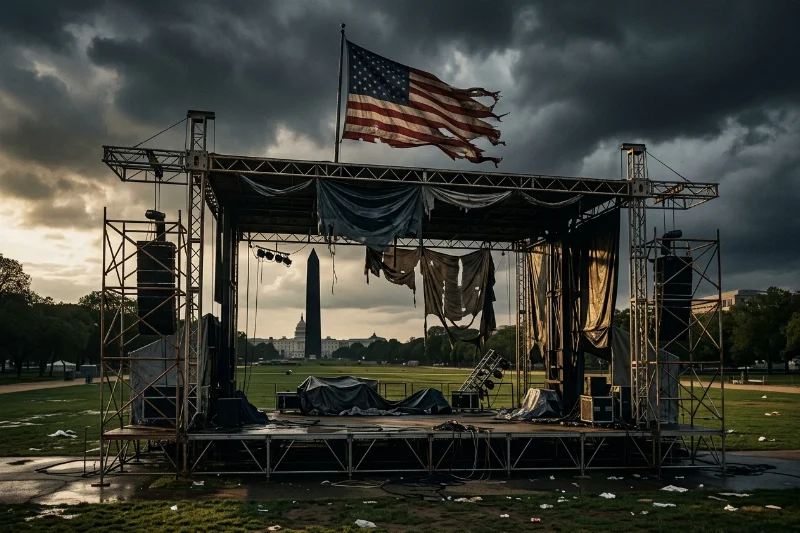
The financial shortfall is perhaps the most glaring issue. The projected costs for security alone are enough to bankrupt the current budget allocations if private funding does not materialize soon. Without a significant infusion of capital or a radical scaling back of the festival’s scope, the event risks being a series of half-finished stages and empty pavilions—a visual metaphor for the very divisions it was meant to help bridge.
The Public Perception Problem
Compounding the internal issues is a massive failure in public relations. Most Americans remain entirely unaware that a national 250th-anniversary celebration is even being planned. The messaging has been fragmented and uninspiring, failing to capture the imagination of a public that is increasingly cynical about government-led initiatives. The “Freedom 250” brand has failed to launch in the way that the Bicentennial did in 1976, which saw a groundswell of local engagement.
There is a distinct lack of grassroots enthusiasm, which is vital for an event of this scale. Instead of a groundswell of national pride, the planning phase has been characterized by silence and occasional news of internal leaks. This void is being filled by critics who argue that the funds could be better spent elsewhere, further eroding the political will to see the project through to its conclusion before the world’s eyes turn to Washington.
In conclusion, the Freedom 250 festival is at a critical crossroads. The race against time is no longer a metaphor; it is a harsh reality. If the White House and the commission cannot overcome the internal bickering and logistical failures that have plagued the project thus far, the 250th anniversary may pass not with a bang of celebration, but with a whimper of missed opportunities. Salvaging the vision requires immediate, decisive action and a return to the unified spirit that the festival was supposed to represent.
