
Hits: 91
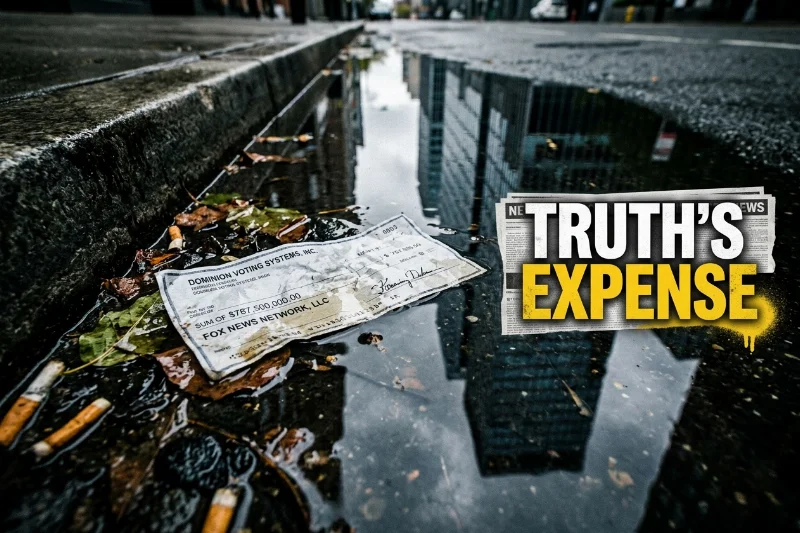
Listen, I’ve spent two decades in the trenches of investigative journalism, and I’ve seen some staggering price tags on human failure. But the $787.5 million Fox News cut a check for in 2023 wasn’t just a settlement; it was a bill for services rendered in the construction of a secondary reality. It’s the kind of money that makes a corporate heart skip a beat, yet in the grand circus of American media, it was treated like an expensive parking ticket. I’ve seen local papers shutter over a few thousand dollars in legal fees, while the giants treat a massive defamation payout as the cost of doing business.
We’re talking about the Dominion Voting Systems lawsuit, a moment that should have been a reckoning but instead felt like a series of redacted emails and a sudden silence on the courthouse steps. If you think this was about the sanctity of the vote, you’re missing the point. This was about the market value of a convenient lie. As someone who watched the industry I loved get stripped for parts by private equity ghouls, seeing a news organization get caught in the machinery of its own making provides a bitter sort of clarity.
The High Price of Manufactured Reality
The core of the issue was simple: Dominion Voting Systems claimed Fox News knowingly aired false allegations that their machines flipped votes in the 2020 election. In my day, if you got a fact that wrong, you didn’t just issue a correction; you cleared out your desk. But the discovery process in this case revealed something much more cynical than a simple mistake. It showed a systemic fear of the audience—a fear that telling the truth would send viewers scurrying to even more extreme corners of the internet.
The Dominion Settlement That Wasn’t a Trial
We were promised a trial for the ages, a moment where the heavyweights of cable news would have to stand under oath and explain why their private texts sounded nothing like their public broadcasts. Instead, we got an eleventh-hour settlement. It’s the oldest trick in the book: when the truth is about to be read into the record by a court reporter, you open the checkbook. Seven hundred and eighty-seven million dollars is a lot of silence to buy, but for a multi-billion-dollar machine, it was a bargain to keep the stars off the witness stand.
I’ve sat in rooms with people who lost their livelihoods because of a single misplaced sentence. Seeing the scale of this deception go unpunished by anything other than a financial transaction is a gut punch to anyone who still believes facts are the bedrock of a functioning society. It tells us that as long as you have the capital, you can treat the truth like a variable instead of a constant. It’s a gritty reality that most people aren’t ready to face, but I’ve been staring at it for years.
The Receipts Fox Didn’t Want You to See
The discovery documents were the real story here, not the money. The texts and emails between anchors and executives were a masterclass in hypocrisy. Privately, they were calling the conspiracy theorists “crazy” and “ludicrous.” Publicly, they were giving those same theories a prime-time platform and a polished veneer of credibility. It wasn’t about belief; it was about retention. They knew the product was tainted, but the customers were addicted, and you don’t stop the supply when the margins are this high.
As a reporter who has seen the decline of civic life firsthand, this is the most depressing part. The news wasn’t being reported; it was being curated to fit a pre-existing psychological need. When your business model relies on keeping people angry and afraid, the truth is just an obstacle to be managed. They managed it by writing a check that would have funded a thousand local newsrooms for a decade, just to make the problem go away.
When Ratings Matter More Than Facts
The internal panic at the network wasn’t over the ethics of the lie, but over the plummeting ratings when they briefly tried to tell the truth. That’s the rot I’ve been talking about. We’ve built an ecosystem where the truth is no longer a viable commercial product. If you tell the people what they don’t want to hear, they leave. And in the boardroom, a departing viewer is a bigger catastrophe than a compromised democracy. It’s a race to the bottom, and we’re all paying the entry fee.
There was no on-air apology, no formal retraction that reached the millions who were fed the fiction for months. That’s the real tragedy. The people who were lied to didn’t even get the closure of a public confession. They were left with the fallout while the corporate entity pivoted to the next outrage. I’ve watched this cycle repeat until the gears are stripped bare, and nobody seems to care as long as the stock price stays stable.
What does it say about us that a news outlet can admit, through a settlement, that it peddled fiction and still remain the most-watched source of information for half the country? It says we’ve given up on the idea of a shared reality. We’re all just choosing which brand of fiction we want to inhabit. The $787 million wasn’t a penalty; it was an investment in maintaining that divide. It kept the machine running without having to face a jury of peers.
In my twenty years of investigative work, I’ve learned that the most dangerous lies aren’t the ones told by villains in dark alleys. They’re the ones told by people in suits under bright studio lights who know exactly what they’re doing. They aren’t delusional; they’re calculating. They weighed the risk of a lawsuit against the reward of market dominance, and they decided the lie was worth the liability. That’s the world we live in now—one where the truth is just another line item on a balance sheet.
I remember a time when a scandal like this would have been the end of a career, if not a company. Now, it’s just a Tuesday in June. We’ve become so numb to the decay that we barely blink at a billion-dollar admission of guilt. We’ve traded our critical thinking for tribal loyalty, and the people at the top are laughing all the way to the bank. They don’t need you to believe them; they just need you to keep watching.
The collapse of local news left a void that these national outlets filled with noise and fury. Without the grounded, gritty reporting of people who actually live in your community, you’re left with these polished gargoyles in New York and D.C. who wouldn’t know a hard day’s work if it hit them in the face. They sold you a story because it was easier than telling you the complicated, boring truth. And when they got caught, they used your viewership to pay the fine.
Don’t expect things to change just because a check was signed. The incentives are still the same, and the audience is still hungry for the next fix. Until we stop treating news like entertainment and start treating it like the vital infrastructure it is, we’re going to keep seeing these massive payouts. But don’t worry, they’ll make that $787 million back in ad revenue by the end of the next election cycle. The house always wins, and in this game, the truth was never even at the table.
