
California Proposed Bill Targets Potential Trump Felon Reparations with 100% Tax Rate

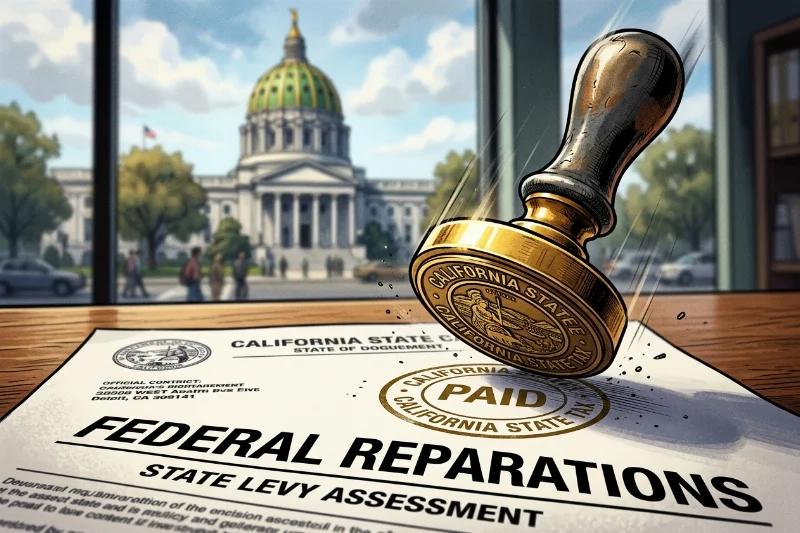
Conceptual image of California taxing federal reparations documents with a state seal.
California introduces a controversial bill to tax potential Trump felon reparations at 100%, sparking a massive legal and political debate over state vs federal power.

Hits: 76

In a move that has sent shockwaves through both Sacramento and Washington, California legislators have introduced a provocative new bill aimed at a hypothetical federal policy. The proposed statute seeks to impose a 100% state tax on any ‘felon reparations’ that might be issued under a future federal administration, specifically targeting rhetoric from the Trump campaign. This preemptive strike highlights the deepening divide between California’s legal framework and the populist economic promises emerging on the national stage.

The Legislative Framework and Sacramento’s Strategy

Legislators behind the bill argue that the state must protect its fiscal integrity against what they characterize as ‘unprecedented federal interference’ with the judicial system. By setting a tax rate of 100%, the bill effectively ensures that any funds transferred from the federal government to individuals under the guise of reparations for legal convictions would immediately flow into California’s general fund. Supporters of the bill suggest this is a necessary deterrent against federal policies that could undermine state-level judicial outcomes. The language of the bill is specifically tailored to apply to individuals residing within California who receive federal disbursements labeled as compensatory for time served in prison or legal fees related to high-profile federal cases. While the bill does not name Donald Trump specifically in the statutory text, the timing of its introduction—coinciding with his campaign’s recent focus on ‘legal vindication’—leaves little doubt among analysts as to its intended target.

Fiscal Mechanisms and the 100% Threshold

Under the proposed code, the California Franchise Tax Board would be granted expanded authority to track federal disbursements categorized as ‘reparative’ or ‘compensatory for judicial overreach.’ The 100% tax threshold is a rare fiscal tool, often reserved for punitive measures or the clawback of ill-gotten gains. In this context, it functions as a total recapture mechanism, preventing any net financial gain for the recipient. Economists have noted that such a high tax rate is likely to face immediate scrutiny from the Internal Revenue Service (IRS) and the Treasury Department. However, proponents in Sacramento argue that state sovereignty allows California to determine its own tax brackets for income received by its residents, regardless of the source of that income. This sets the stage for a massive accounting battle over the definition of taxable income versus federal grants.

Constitutional Challenges and the Supremacy Clause

Legal scholars are already weighing in on the constitutionality of the proposed tax. The primary hurdle remains the Supremacy Clause of the U.S. Constitution, which dictates that federal law generally takes precedence over state law. If a federal reparations program were enacted by Congress, a state-level tax designed specifically to nullify that program could be viewed as an unconstitutional obstruction of federal policy. Critics of the bill argue that it constitutes a ‘bill of attainder’ or a targeted piece of legislation that punishes a specific group without a trial. They contend that by singling out recipients of specific federal funds, California is overstepping its administrative bounds. ‘You cannot use the tax code as a political weapon to effectively seize federal payments,’ said one legal analyst based in Los Angeles, predicting a swift filing in the Ninth Circuit Court of Appeals.

Political Implications for the 2024 Election

The political optics of the bill are equally significant. For California Democrats, the move serves as a signal to their base that the state remains the ‘headquarters of the resistance’ against a potential second Trump term. By framing the issue as a defense of the rule of law and state fiscal independence, they are forcing a debate on the legitimacy of using federal funds to provide financial relief to those with criminal convictions. On the other side of the aisle, Republican strategists are using the proposal to illustrate what they call ‘California’s tax-and-spend extremism.’ They argue that the state is willing to weaponize its bureaucracy to settle political scores, a narrative that resonates with voters concerned about government overreach. This legislative battle is expected to serve as a primary talking point in upcoming stump speeches across the country. As the bill moves through the committee process in Sacramento, the eyes of the nation remain fixed on the West Coast. Whether this 100% tax ever becomes law—or survives a certain court challenge—it has already achieved its primary goal: creating a definitive line in the sand between the state of California and the future of federal judicial policy. The coming months will determine if this is a viable legal strategy or merely a high-stakes piece of political theater.