
Hits: 146
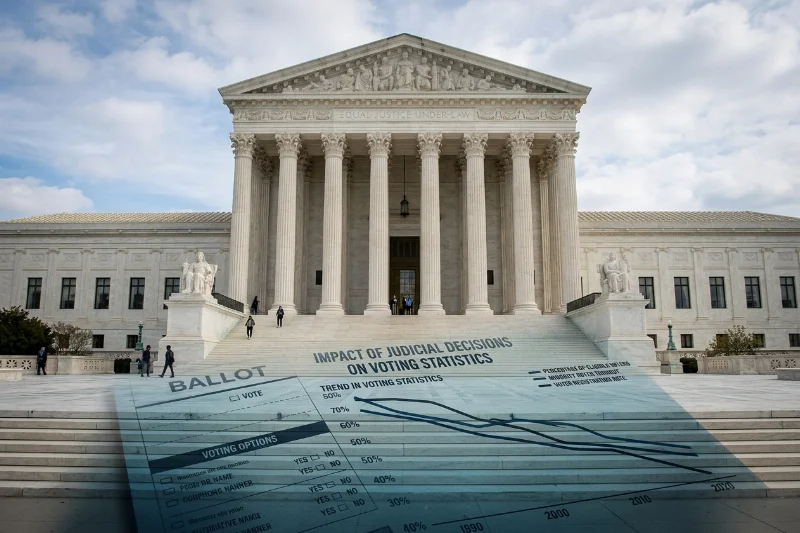
The Foundation of Shelby County v. Holder
\n\n\nIn 2013, the landmark Supreme Court decision in Shelby County v. Holder fundamentally altered the landscape of American democracy by striking down Section 4(b) of the Voting Rights Act (VRA). The Court’s majority argued that the formula used to determine which jurisdictions required federal oversight—known as preclearance—was based on decades-old data that no longer reflected current realities. By declaring the coverage formula unconstitutional, the Court effectively neutralized Section 5, which had previously prevented jurisdictions with a history of discrimination from implementing new voting laws without federal approval.
\n\n\n\nThe Disputed Metrics of Racial Parity
\n\n\nAt the heart of Chief Justice John Roberts’ majority opinion was the assertion that African American voter registration and turnout rates had achieved parity with white voters in the covered Southern states. However, legal scholars and voting rights advocates have since argued that this data was misleadingly narrow. While raw registration numbers had indeed risen, the data ignored the persistent gap in localized turnout and the emergence of more subtle, second-generation barriers to voting. By focusing on a single metric, the Court overlooked the systemic obstacles that the preclearance requirement was specifically designed to mitigate.
\n\n\n\nContextual Omissions in Judicial Reasoning
\n\n\nFurther analysis of the data used by the Court suggests a significant oversight regarding the “deterrent effect” of the VRA. The statistics showing high minority participation were collected while Section 5 was still in active use, meaning the data reflected a voting environment protected by federal oversight. To use data generated under the protection of a law to argue that the law is no longer necessary constitutes a logical fallacy that many experts believe led to a premature dismantling of federal protections. This misinterpretation failed to account for how quickly discriminatory practices could return once the oversight was removed.
\n\n\n\nThe Immediate Impact of the Ruling
\n\n\nThe consequences of the Shelby decision were almost immediate, as several states previously covered by Section 5 moved to implement restrictive voting laws within hours of the ruling. These measures included strict voter ID requirements, the closure of hundreds of polling locations in minority-heavy districts, and the purging of voter rolls. The surge in these legislative changes provided empirical evidence that the “changes” in the South cited by the Court were perhaps more fragile than the judicial majority had assumed, as the removal of federal barriers led to a swift resurgence in restrictive practices.
\n\n\n\nStatistical Evidence of New Barriers
\n\n\nRecent studies by the Brennan Center for Justice and other non-partisan organizations have highlighted a widening gap in voter turnout between white and non-white voters in formerly covered jurisdictions since 2013. These statistics suggest that the “false data” of parity was a snapshot in time rather than a permanent shift in the political landscape. By removing the proactive protection of preclearance, the burden of proof shifted to disenfranchised voters, who must now engage in costly and time-consuming litigation under Section 2 of the VRA to challenge discriminatory laws after they have already taken effect.
\n\n\n\nThe Path Forward for Voting Rights Legislation
\n\n\nThe controversy surrounding the data used in the Shelby County decision has fueled calls for Congress to pass the John Lewis Voting Rights Advancement Act. This proposed legislation aims to establish a new, modern coverage formula based on recent evidence of voting rights violations rather than the contested registration metrics of 2013. Ensuring that judicial decisions are based on comprehensive, multi-dimensional data is essential for protecting the integrity of the ballot box and ensuring that the progress made since 1965 is not permanently reversed by a misunderstanding of current social dynamics.
\n